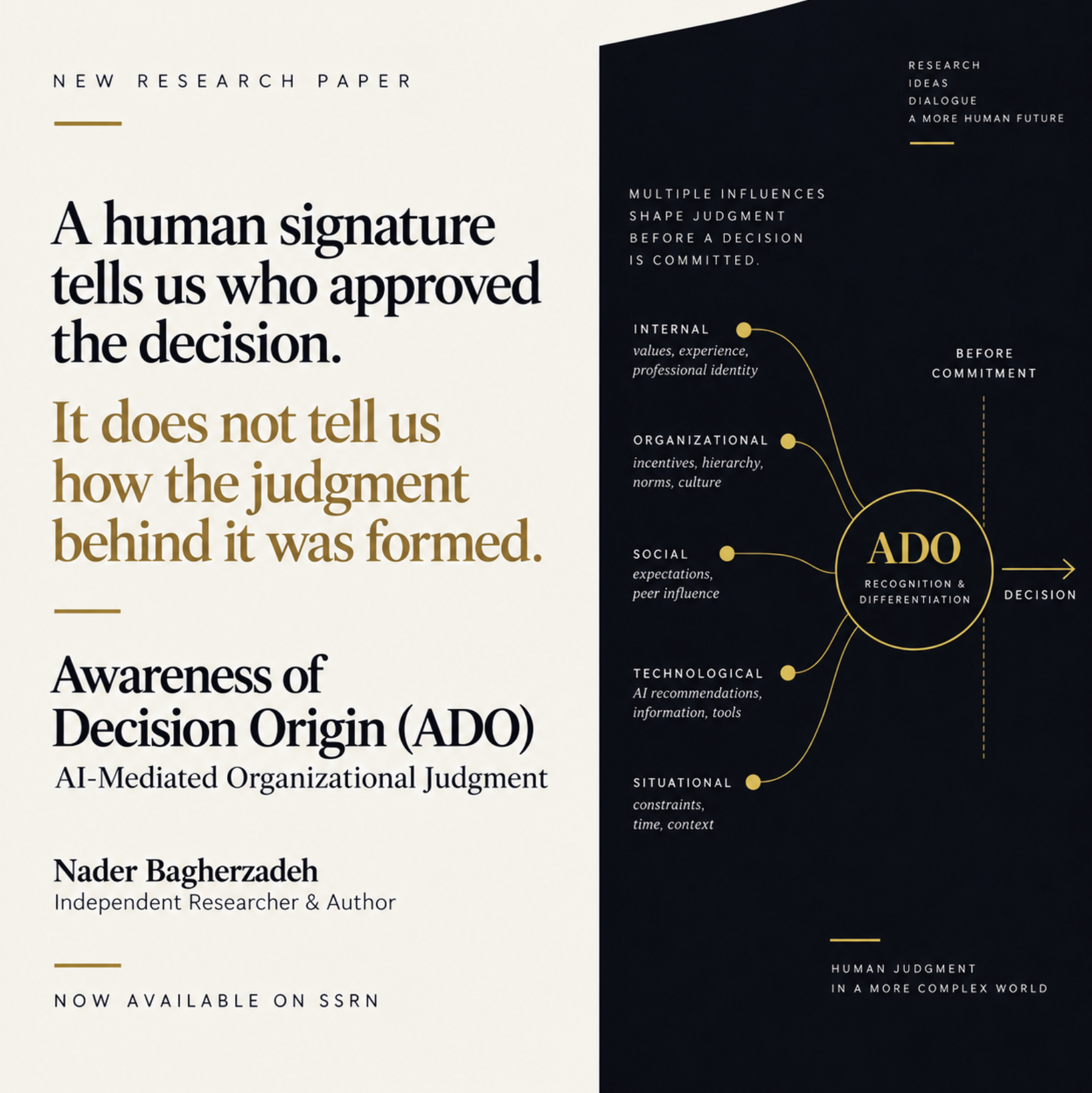
مقاله پژوهشی «Awareness of Decision Origin in AI-Mediated Organizational Judgment» نوشته نادر باقرزاده، معرفیکننده ADO بهعنوان یک سازه پیشنهادی پیش از تصمیم در زمینه قضاوت انسانی، تصمیمگیری سازمانی و هوش مصنوعی مسئولانه؛ منتشرشده در SSRN در سپتامبر 2026.
Abstract
Artificial intelligence is increasingly embedded in organizational decision processes through recommendations, rankings, predictions, summaries, risk assessments, and generated alternatives. Human decision-makers may nevertheless remain formally responsible for the choices that follow. Formal human involvement, however, does not reveal how the underlying judgment was formed, which influences shaped it, or whether those influences became available for examination before commitment.
This article develops a pre-decisional question: can decision-makers recognize and distinguish materially relevant influences shaping their judgment while that judgment is still being formed? It proposes Awareness of Decision Origin (ADO) as the situated recognition and differentiation of materially relevant influences shaping judgment before commitment to a consequential decision. Such influences may be internal, organizational, social, technological, or situational.
The proposed construct is positioned in relation to metacognition, source monitoring, algorithmic reliance, automation bias, human oversight, decision provenance, and emerging accounts of human agency in AI-mediated environments. Its intended distinction is not whether a person can identify the source of information, accepts or rejects AI advice, or retains formal authority. The narrower issue is whether materially relevant influences become sufficiently recognizable and differentiable to enter examination while the decision remains open.
The article establishes boundaries separating influence awareness from agency, voice, authority, decision quality, and subsequent action, and develops a staged research programme beginning with qualitative construct elicitation. Subsequent tests include discriminant and incremental validity, experimental manipulation of judgment-shaping influences, behavioral correspondence, and organizational field research.
ADO remains a conceptual proposal. Its status as a separate construct depends on future evidence that the phenomenon is coherent, empirically detectable, and sufficiently distinct from neighboring constructs. If those conditions are not supported, ADO should be narrowed, integrated with existing theory, reorganized, or abandoned.
Keywords: Awareness of Decision Origin; Human Judgment; AI-Mediated Decision-Making; Organizational Decision-Making; Human–AI Interaction; Pre-Decisional Awareness; Metacognition; Human Oversight; AI Governance; Organizational Behavior.
Author: Nader Bagherzadeh Published: September 2026 DOI: 10.2139/ssrn.7463999
Global Rare Impact Theory (GRIT) visual illustrating Inner Rare Authenticity, Rare Inner Code, and ethical leadership in the age of artificial intelligence.
The Global Rare Impact Theory: Official Conceptual and Academic Introduction
Bagherzadeh, N. (2025). The Global Rare Impact Theory: Official conceptual and academic introduction (Working paper). RAREIMPACTGLOBAL Foundation
In this conceptual working paper, I introduce the Global Rare Impact Theory as the formal backbone behind a question that has been present for many years in my fieldwork and personal journey: How can the inner awakening of a single human being truly reshape relationships, organizations, and even civilization – and not remain just an inspiring idea? The Global Rare Impact Theory (GRIT) offers a transdisciplinary architecture that weaves together the R.A.R.E® model of Inner Rare Authenticity and the I.M.P.A.C.T® axis of outer transformation. Instead of treating authenticity as a soft psychological preference, the theory positions it as a structural human variable that can shape leadership, coaching praxis, economic design, and the integration of artificial intelligence into human life. At the micro level, GRIT examines how individuals remember and embody what I call the Rare Inner Code – a unique configuration of awareness, meaning, and potential that I have observed repeatedly in coaching conversations, leadership labs, and my own inner experience. At the macro level, the theory traces how this inner code can extend outward: first into relationships and teams, then into organizations, social systems, and the longer arc of civilizational evolution. Within this context, the AI × AI² (Artificial Intelligence × Authentic Intelligence) paradigm functions as a civilizational lens. Artificial intelligence expands computational capacity and reach; Authentic Intelligence grounds that expansion in awareness, dignity, and meaning. The theory argues that sustainable progress in the age of AI cannot be reduced to more innovative algorithms alone. It depends on whether human beings grow in presence, ethical clarity, and inner coherence at least as fast as their technologies evolve. Drawing on leadership science, coaching research, AI ethics, economics, and civilization studies, along with fourteen years of lived coaching practice, this paper offers a civilization-scale framework for conscious 2 leadership, meaning-driven economies, awareness-based governance, and ethical human– technology coexistence. It is intended as the official conceptual and academic introduction to the forthcoming book, The Global Rare Impact Theory: From Inner Rare Authenticity to Global Impact, and as an open invitation for researchers, leaders, and practitioners to examine authenticity not as a slogan, but as an infrastructure for the future of humanity. This paper functions as the foundational working paper for a series of forthcoming ISI/Scopus-indexed articles based on the Global Rare Impact Theory (GRIT).
Funder Statement
This conceptual and theory-building work did not receive any specific grant from funding agencies in the public, commercial, or not-for-profit sectors. It has been developed as part of the author’s long-term independent research and reflective practice in leadership, coaching, human development, and AI ethics, conducted under the auspices of the RAREIMPACTGLOBAL Foundation. Any costs associated with the writing, editing, and dissemination of this paper were self-funded by the author
.
Suggested Citation:
Bagherzadeh, Nader, The Global Rare Impact Theory: Official Conceptual and Academic Introduction (November 24, 2025). Bagherzadeh, N. (2025). The Global Rare Impact Theory: Official conceptual and academic introduction (Working paper). RAREIMPACTGLOBAL Foundation, Available at SSRN:
The Global Rare Impact Theory (GRIT) is an original theoretical framework developed by Nader Bagherzadeh under the RAREIMPACTGLOBAL initiative.
The Global Rare Impact Coaching Theory (GRIC) and the Rare Inner Code Discovery Protocol (RICDP-C): A Practice Architecture for Inner-Driven Coaching and Ethical Leadership in the Age of AI
The Concept of Inner Rare Authenticity as an Ethical Framework: Exploring the Global Rare Impact Theory and the Future of Business Ethics in the Age of Artificial Intelligence